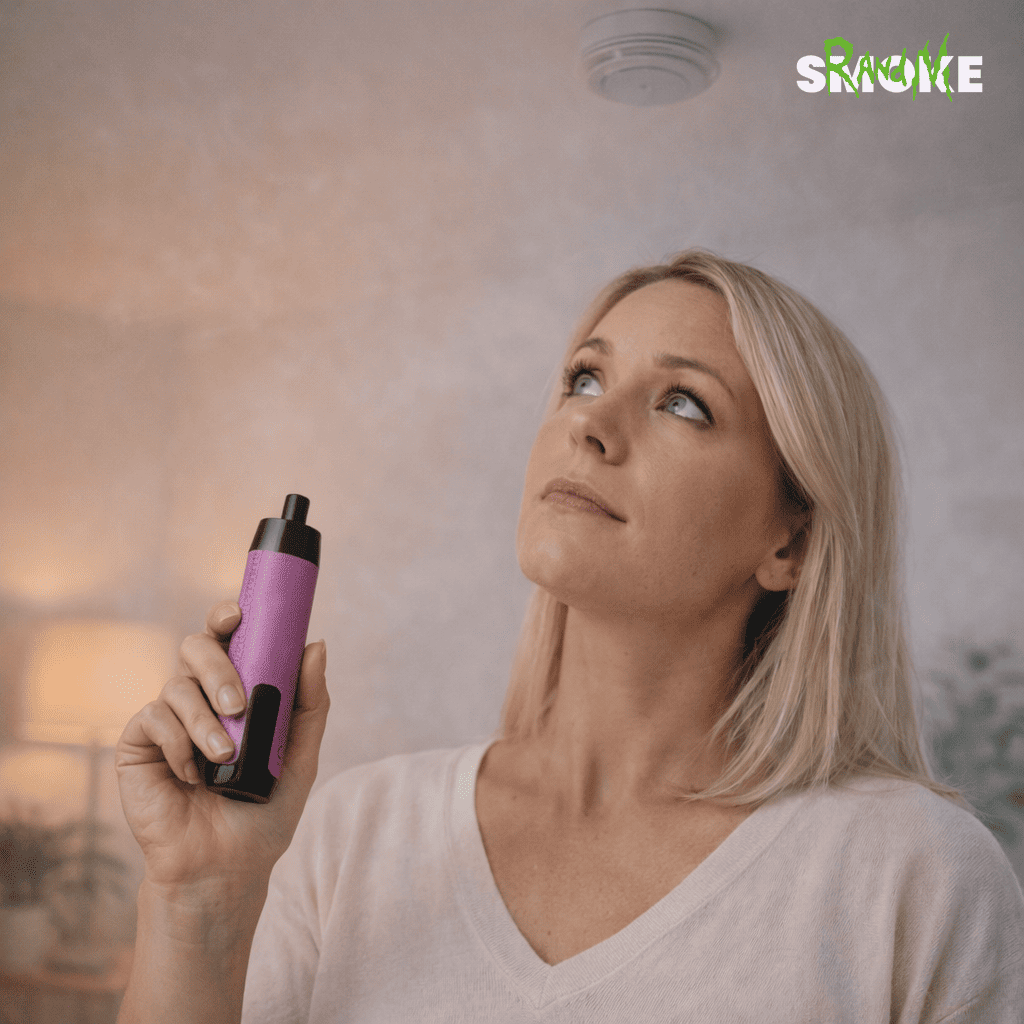
It's a common concern: taking a puff in the living room and suddenly the smoke detector beeps. Or the fear is already present, especially in hotel rooms, rented apartments, or new buildings with sensitive detectors. The short truth: A RandM Vape is not smoke, but it can still trigger an alarm under certain conditions. Not because of the "brand," but because of physics and sensor technology.
If you want to get an overview of all models: View RandM Vapes.
Why the topic is so often misunderstood
Many people automatically equate visible vapor with smoke. This is understandable, but technically incorrect. Smoke detectors do not react to "fire" or "nicotine," but in many cases to particles in the air. And that's exactly why dense aerosol can sometimes trigger the same response as smoke or fog.
How smoke detectors really work
Optical smoke detectors are most commonly installed in homes. They have a small measuring chamber inside with a light beam. If enough particles enter, the light is scattered and the detector alarms.
This means: Not only smoke can trigger them, but also things like dust, fog, or very dense vapor, depending on the concentration and proximity.
Other types of detectors (less common in private areas) react to different particle sizes, but the core remains: the more particles that land in the measuring chamber in a short time, the more likely an alarm will occur.
Vape vapor is not smoke, but an aerosol
Vape vapor is an aerosol made of fine droplets. It is:
- visible
- highly concentrated for short periods
- lighter than many think and rises in the room
This is the crucial point. If this aerosol, in a sufficiently high concentration, gets directly into the detector's area, it can be recognized as a "particle event."
When a RandM Vape can trigger a smoke detector
These situations significantly increase the risk:
-
Lots of vapor in a short time
Several deep puffs one after another create a dense cloud. -
Small room with no air exchange
In the bathroom, bedroom, or a small hotel room, aerosol remains longer and rises. -
Too close to the smoke detector
Directly below it or in its vicinity, the probability increases massively. -
Sensitive or new detectors
Some systems are set more sensitively, especially in hotels or new buildings.
Typical scenarios where it happens more often
- Hotel rooms: often very sensitive detectors, high risk, even with just a few puffs.
- Bedrooms: little air exchange at night, aerosol can accumulate.
- New buildings: modern systems and stricter sensor settings.
- Bathroom: "I'll do it in the bathroom" is a classic mistake, because the room is small and vapor quickly rises.
Do larger devices make this more likely?
Not automatically, but indirectly: devices that produce a lot of volume per puff can create a high particle concentration faster. This is not a quality problem, but simply more aerosol at once. However, room size, distance, and usage behavior always remain decisive.
Common misconceptions
"The device is to blame."
Mostly it's the combination of room, distance, quantity, and air circulation.
"This only happens with cheap vapes."
Wrong. Even high-quality devices can trigger an alarm if vaped densely and close enough.
"No nicotine means it won't trigger."
Nicotine plays no role for the smoke detector. It's about particles, not ingredients.
How to avoid alarms when vaping
These points reduce the risk the most:
- Keep your distance: never vape directly under a smoke detector
- Ventilate: short air exchange noticeably reduces particle concentration
- Less volume: preferably a few calm puffs rather than large clouds
- Room choice: large rooms are significantly less critical than small ones
- No "test sessions": do not take several puffs in a row to check if it triggers
Hotel, Airbnb, rented apartment: why caution is smarter
Here, it's not just about "whether it's technically smoke," but what happens when an alarm goes off. A triggered smoke detector can lead to, depending on the property:
- Trouble with landlords
- Costs
- in the worst case, emergency services
even if there is no fire.
Pragmatic rule: If you're not sure, don't take the risk. It's the cheaper decision.
If your vaping behavior seems unusual
If a device suddenly seems extremely dense, biting, or atypical, it's worth cleanly narrowing down the cause. Sometimes it's usage and environment, sometimes it's a device problem. If the origin and authenticity are in question, a check is advisable.
FAQ
Does a RandM Vape trigger a smoke detector?
Under certain circumstances yes, especially with dense aerosol and close proximity.
Is vape vapor smoke?
No. But smoke detectors often react to particles in the air.
Are small devices safer than large ones?
Not automatically. Usage and room are more decisive than model size.
Can I vape in a hotel?
Technically possible, practically risky. Hotel detectors are often very sensitive.
Does the brand make a difference?
Mostly no. Room, distance, air exchange, and cloud density are the main factors.
How do I avoid alarms?
Distance, ventilate, less vapor at once, prefer large rooms.
A RandM Vape is not smoke, but dense vapor can trigger smoke detectors under certain conditions. Those who keep their distance, ventilate, and do not "produce clouds" avoid most problems. In sensitive environments like hotels, caution is almost always the smarter choice.